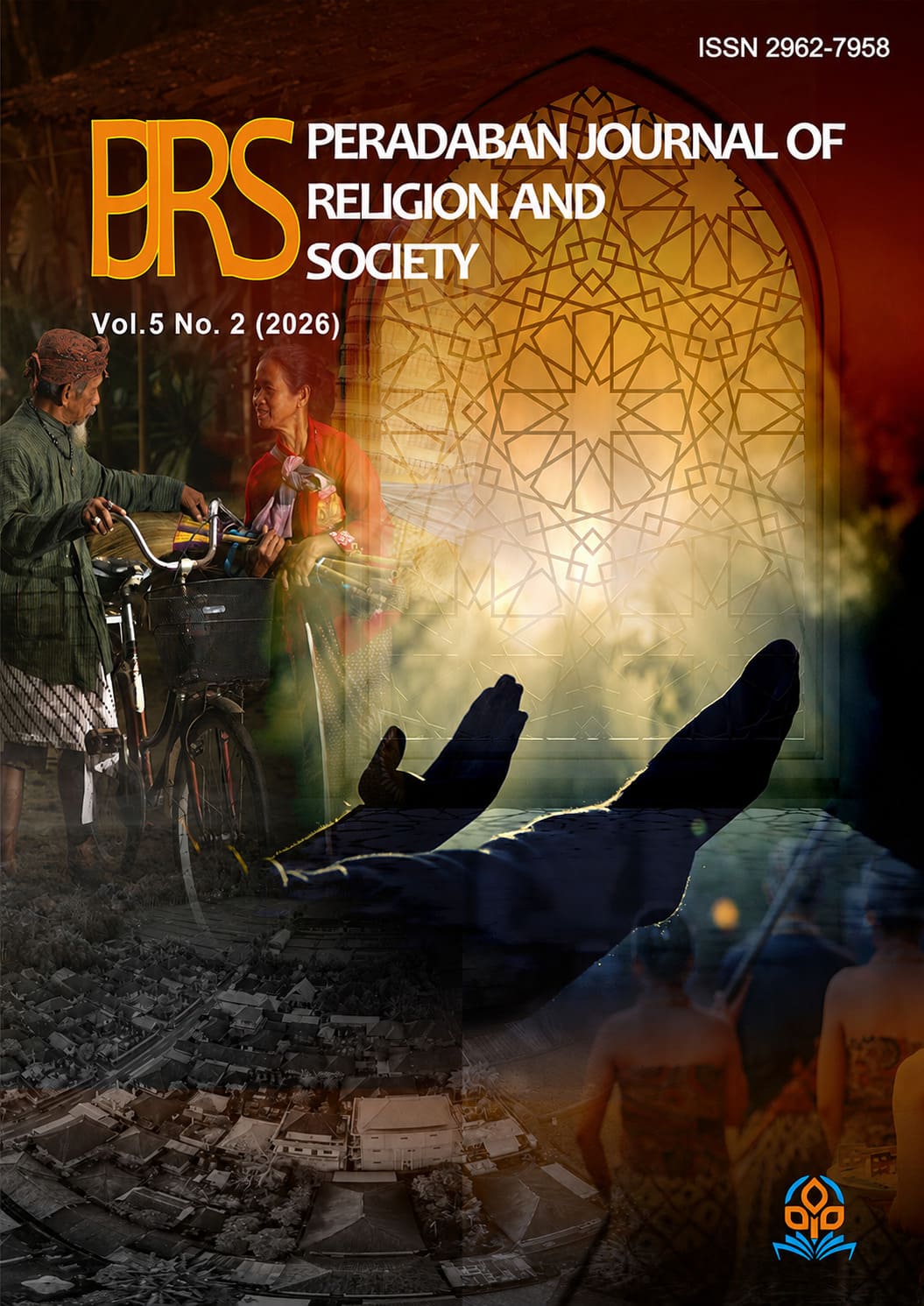
Reconstructing the Role of Religion in Ecological Conservation
A Comparative Analysis of Lynn White Jr. and Vandana Shiva in Indonesia
DOI:
https://doi.org/10.59001/pjrs.v5i2.1292Keywords:
Environmental Justice, Lynn White Jr., Religion and Ecology, Religious Ecological Guardianship Framework, Vandana ShivaAbstract
The ecological crisis requires approaches that address not only environmental degradation but also the religious worldviews and socio-political structures that shape human–nature relations. This study examines the role of religion in ecological conservation through a comparative analysis of Lynn White Jr. and Vandana Shiva. Using qualitative library research and comparative conceptual analysis, the study examines White’s critique of religious anthropocentrism and Shiva’s analysis of colonialism, capitalism, patriarchy, developmentalism, and Indigenous ecological knowledge. The findings indicate that White and Shiva identify complementary dimensions of ecological degradation: White highlights how religious worldviews can legitimize human domination of nature, while Shiva demonstrates how such domination is reproduced through structures of power and economic exploitation. Their synthesis suggests that religion is neither inherently a cause of ecological degradation nor automatically a solution, but can become a transformative ecological actor when theological and ethical reconstruction is connected with structural engagement and ecological justice. Based on this synthesis, the study proposes the Religious Ecological Guardianship Framework (REGF), consisting of five interconnected pillars: theological reinterpretation, interreligious ecological ethics, recognition of Indigenous knowledge, ecological justice, and institutional and civic collaboration. Applied to the Indonesian context, the framework positions religion as a potential bridge between spiritual values, Indigenous knowledge, community action, and environmental governance. As a conceptual framework, REGF requires further empirical validation across Indonesia’s diverse religious and socio-ecological contexts.
Krisis ekologis memerlukan pendekatan yang tidak hanya menangani kerusakan lingkungan, tetapi juga pandangan dunia keagamaan dan struktur sosio-politik yang membentuk hubungan antara manusia dan alam. Penelitian ini menguji peran agama dalam konservasi ekologis melalui analisis komparatif atas pemikiran Lynn White Jr. dan Vandana Shiva. Menggunakan metode penelitian pustaka kualitatif dan analisis konseptual komparatif, studi ini mengkaji kritik White terhadap antroposentrisme keagamaan serta analisis Shiva mengenai kolonialisme, kapitalisme, patriarki, pembangunanisme (developmentalism), dan pengetahuan ekologis masyarakat adat. Temuan penelitian menunjukkan bahwa White dan Shiva mengidentifikasi dimensi kerusakan ekologis yang saling melengkapi: White menyoroti bagaimana pandangan dunia keagamaan dapat melegitimasi dominasi manusia atas alam, sementara Shiva menunjukkan bagaimana dominasi tersebut direproduksi melalui struktur kekuasaan dan eksploitasi ekonomi. Sintesis pemikiran keduanya menunjukkan bahwa agama pada dasarnya bukanlah penyebab kerusakan ekologis maupun solusi yang serta-merta otomatis, melainkan dapat menjadi aktor ekologis yang transformatif ketika rekonstruksi teologis dan etis dihubungkan dengan keterlibatan struktural dan keadilan ekologis. Berdasarkan sintesis ini, penelitian ini mengajukan Religious Ecological Guardianship Framework (REGF), yang terdiri dari lima pilar yang saling terhubung: reinterpretasi teologis, etika ekologis antariman, pengakuan atas pengetahuan masyarakat adat, keadilan ekologis, serta kolaborasi institusional dan kewargaan. Diterapkan dalam konteks Indonesia, kerangka kerja ini memposisikan agama sebagai jembatan potensial antara nilai-nilai spiritual, pengetahuan lokal/adat, aksi komunitas, dan tata kelola lingkungan. Sebagai sebuah kerangka konseptual, REGF memerlukan validasi empiris lebih lanjut di berbagai konteks keagamaan dan sosio-ekologis yang beragam di Indonesia.
Downloads
References
Bowen, G. A. (2009). Document analysis as a qualitative research method. Qualitative Research Journal, 9(2), 27–40. doi:10.3316/QRJ0902027
Conradie, E. M. (2006). Christianity and ecological theology: Resources for further research. Stellenbosch, South Africa: SUN Press.
Creswell, J. W., & Poth, C. N. (2018). Qualitative inquiry and research design: Choosing among five approaches (4th ed.). Thousand Oaks, CA: SAGE Publications.
Foltz, R. C., Denny, F. M., & Baharuddin, A. (Eds.). (2003). Islam and ecology: A bestowed trust. Cambridge, MA: Harvard University Press.
Global Forest Watch. (2024). Global Forest Watch: Indonesia dashboard. Retrieved from https://www.globalforestwatch.org
Gottlieb, R. S. (2006). A greener faith: Religious environmentalism and our planet's future. New York, NY: Oxford University Press.
Grim, J., & Tucker, M. E. (2014). Ecology and religion. Washington, DC: Island Press.
Intergovernmental Panel on Climate Change. (2023). Climate change 2023: Synthesis report. Geneva, Switzerland: IPCC.
Intergovernmental Science-Policy Platform on Biodiversity and Ecosystem Services. (2019). Global assessment report on biodiversity and ecosystem services. Bonn, Germany: IPBES Secretariat.
Jenkins, W. (2009). Ecologies of grace: Environmental ethics and Christian theology. New York, NY: Oxford University Press.
Lansing, J. S. (2006). Perfect order: Recognizing complexity in Bali. Princeton, NJ: Princeton University Press.
Maksum, A., Kholish, M. A., Halim, W., Sukron, A., & Harwanto, A. P. (2025). Penguatan fatwa hijau Nahdlatul Ulama dan pentingnya konservasi mangrove berkelanjutan di pesisir Paciran. Wisesa: Jurnal Pengabdian Masyarakat, 4(1), 31–36. doi:10.21776/ub.wisesa.2025.04.1.6
Mangunjaya, F. M. (2011). Developing environmental awareness and conservation through Islamic teaching. Journal of Islamic Studies, 22(1), 36–49.
Mies, M., & Shiva, V. (1993). Ecofeminism. London, England: Zed Books.
Nash, R. F. (1989). The rights of nature: A history of environmental ethics. Madison, WI: University of Wisconsin Press.
National Plastic Action Partnership Indonesia. (2020). Radically reducing plastic pollution in Indonesia: A multistakeholder action plan. Geneva, Switzerland: World Economic Forum.
Shiva, V. (1988). Staying alive: Women, ecology and survival in India. London, England: Zed Books.
Shiva, V. (1991). The violence of the Green Revolution: Third World agriculture, ecology and politics. London, England: Zed Books.
Shiva, V. (1993). Monocultures of the mind: Perspectives on biodiversity and biotechnology. London, England: Zed Books.
Shiva, V. (2005). Earth democracy: Justice, sustainability, and peace. Cambridge, MA: South End Press.
Shiva, V. (2008). Soil not oil: Environmental justice in an age of climate crisis. Cambridge, MA: South End Press.
Shiva, V. (2016). Who really feeds the world? The failures of agribusiness and the promise of agroecology. Berkeley, CA: North Atlantic Books.
Snyder, H. (2019). Literature review as a research methodology: An overview and guidelines. Journal of Business Research, 104, 333–339. doi:10.1016/j.jbusres.2019.07.039
Tucker, M. E., & Grim, J. (Eds.). (2001). Religion and ecology: Can the climate change? Daedalus, 130(4), 1–306.
White, L., Jr. (1967). The historical roots of our ecologic crisis. Science, 155(3767), 1203–1207. doi:10.1126/science.155.3767.1203
Zed, M. (2014). Metode penelitian kepustakaan. Jakarta, Indonesia: Yayasan Pustaka Obor Indonesia.